If you have worked in a veterinary clinic recently, you probably do not need a study to confirm how strained things feel. Schedules are packed, wait times are long, and staff are often expected to cover more than one role. So when someone asks, "Is there really a veterinarian shortage?" the answer may seem obvious: of course there is.
Yet the workforce literature tells a more complicated story than most headlines suggest. The research confirms real strain across the profession, but experts disagree on whether "shortage" is the right term, and that division deserves a closer look.
Evidence of a shortage

The American Association of Veterinary Medical Colleges (AAVMC) is a prominent source of evidence for a shortage.
Its 2024 workforce statement reports that the U.S. veterinarian population has grown by about 2.7% annually since 2007, while demand for veterinary services has risen by more than 6% per year after adjusting for inflation. It also estimates that in 2019, open positions outnumbered available veterinarians by 2,000 to 3,000.
The American Association of Veterinary Medical Colleges (AAVMC) is a prominent source of evidence for a shortage. Its 2024 workforce statement reports that the U.S. veterinarian population has grown by about 2.7% annually since 2007, while demand for veterinary services has risen by more than 6% per year after adjusting for inflation. It also estimates that in 2019, open positions outnumbered available veterinarians by 2,000 to 3,000.
Long-term projections point in the same direction. Lloyd's 2023 analysis, summarized by Gitter and LaFayette (2024), estimated a 2030 shortfall of roughly 14,000 to 24,000 companion animal veterinarians. Lloyd's report also projects that meeting demand may require up to 55,000 additional veterinarians by 2030, while more than 12,500 companion animal veterinarians are expected to retire. Gitter and LaFayette used a different method, basing their estimate on Bureau of Labor Statistics projections for occupational growth and turnover rather than demand drivers such as household spending on veterinary care. They concluded that the profession will need about 70,092 new veterinarians through 2032, with projected graduates filling only about 76% of that need.
Where the disagreement begins

Notably, these two analyses reached similar conclusions. Still, projections depend on assumptions that are not universally accepted.
In 2023, leaders of the American Veterinary Medical Association (AVMA) challenged the shortage forecasts, stating that the number of companion animal veterinarians would grow by more than 20% from 2022 to 2030, from about 80,000 to more than 98,000 (AVMA, 2023).
As described by Gitter and LaFayette (2024), the AVMA projected greater supply and lower demand than Lloyd, resulting in an estimated surplus of about 8,200 companion animal veterinarians by 2030. Gitter and LaFayette also noted that both earlier studies used incomplete proxies for demand.
Notably, these two analyses reached similar conclusions. Still, projections depend on assumptions that are not universally accepted. In 2023, leaders of the American Veterinary Medical Association (AVMA) challenged the shortage forecasts, stating that the number of companion animal veterinarians would grow by more than 20% from 2022 to 2030, from about 80,000 to more than 98,000 (AVMA, 2023). As described by Gitter and LaFayette (2024), the AVMA projected greater supply and lower demand than Lloyd, resulting in an estimated surplus of about 8,200 companion animal veterinarians by 2030. Gitter and LaFayette also noted that both earlier studies used incomplete proxies for demand.
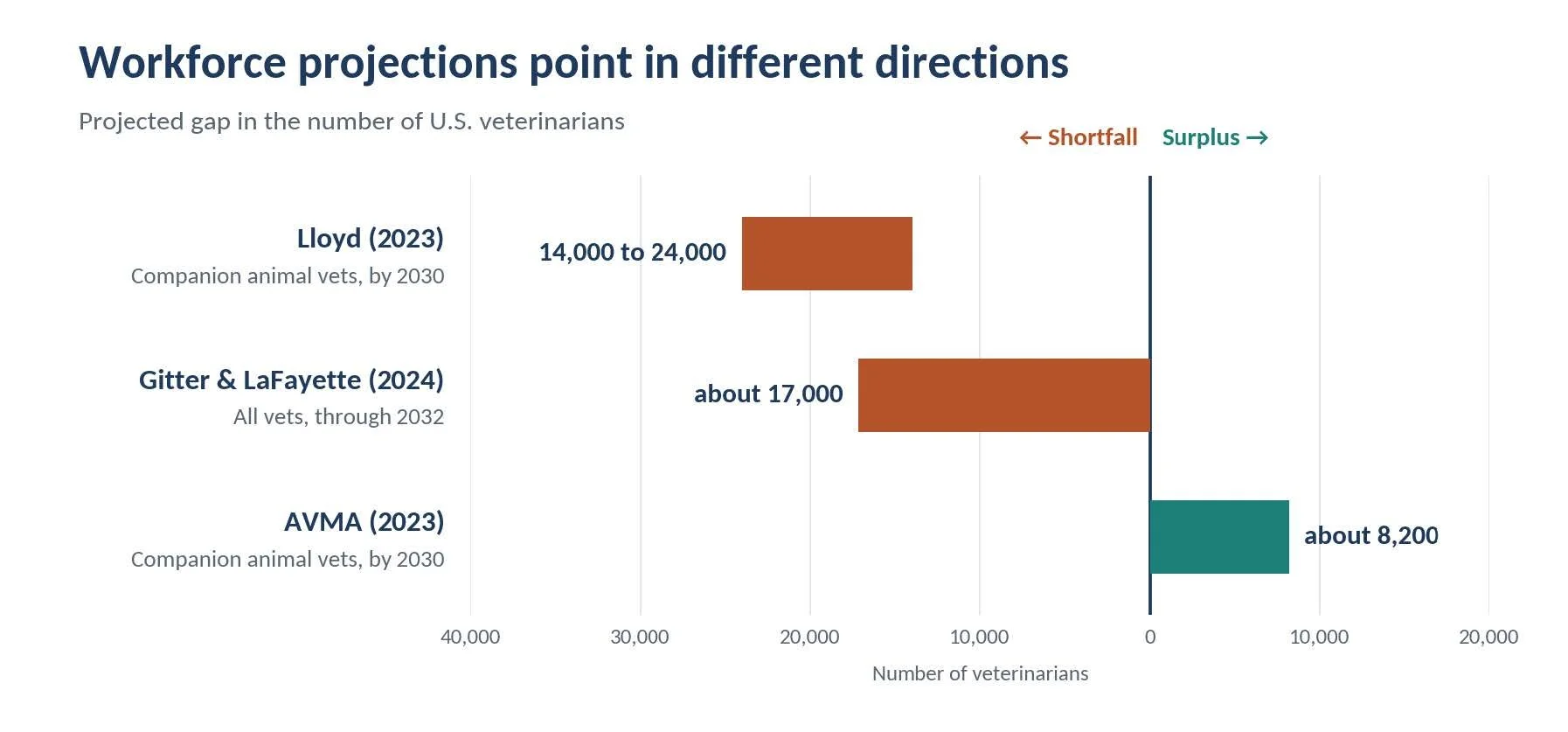
Projections differ in scope and time frame and are shown to compare direction, not exact size. Lloyd's range and the AVMA surplus are cited as described in Gitter and LaFayette (2024). The Gitter and LaFayette figure is calculated from their reported need (70,092) and projected graduates (52,926).
Neill and Salois, who write on veterinary economics, add another perspective in a 2024 viewpoint article in the Journal of the American Veterinary Medical Association (Neill & Salois, 2024). They distinguish scarcity, a normal feature of markets, from market failure, which occurs when structural barriers prevent a market from adjusting. In their view, rising veterinary salaries and hiring bonuses indicate that the market is responding. They acknowledge that the four-year training pipeline creates a delay, but argue that a delay does not mean the system has failed.
Their broader argument is that asking how many veterinarians the profession needs may be the wrong question. Economics can quantify demand, meaning what people want and will pay for, but it cannot put a number on need. Instead, they recommend asking what the profession aims to achieve and at what cost. They also note that organizations have conducted separate analyses using different data and assumptions, and they call for shared, unbiased, publicly accessible data. Because this is a viewpoint article, it presents the authors' reasoned position rather than new empirical findings.
How the strain affects veterinary practice

Whatever term is used, the pressure on clinics is well documented. A 2023 IDEXX analysis of more than 750 practices and 4.2 million clinical visits estimated that veterinarians may need to increase productivity by as much as 40% by 2030 to meet projected demand (Fetaih & Johnson, 2023).
The report also found that 21% of U.S. practices reduced or ended weekend services in 2022, either to support work-life balance or because they lacked enough staff to remain open.
The AAVMC also reports that 20% to 30% of veterinarians each year would prefer to work fewer hours, even for less pay (AAVMC, 2024). Gitter and LaFayette note that recent studies found more than 40% were considering leaving the profession before retirement. These findings show how workforce pressures and well-being are intertwined. Burnout-related turnover and reduced clinical hours are estimated to cost $1.57 billion to $2.33 billion annually (Neill et al., 2022), and Gitter and LaFayette identify veterinarian mental health as a priority for addressing the supply gap. Workforce strain affects the people within it; when they reduce their hours or leave, the strain deepens.
Is there a shortage?

The most accurate answer depends on how "shortage" is defined and who measures it. Researchers disagree on whether veterinarian demand truly exceeds supply and, if so, by how much.
Still, the two sides meet on one point: retention matters. Even the AVMA, which challenges shortage projections, acknowledges a short-term problem and identifies hours, pay, practice culture, and work-life support as key reasons veterinarians stay (AVMA, 2023).
Demand for care has grown, the supply of new veterinarians adjusts slowly, and both practices and their teams are feeling the strain.
What does this mean for you

You cannot close a national workforce gap on your own, nor should anyone expect you to. Practice leaders, organizations, and the profession share responsibility for veterinarians' working conditions.
Feeling stretched is a reasonable response to an overburdened system, not a personal failing.
At the same time, the skills you develop stay with you. Setting boundaries, communicating clearly under pressure, and adapting how you cope can help you remain steady as the larger debate continues. Sustainable veterinarians build sustainable skills, and you can start now, without waiting for the workforce question to be resolved.
Sources
American Association of Veterinary Medical Colleges. (2024, March 13). AAVMC statement on U.S. veterinary workforce. https://www.aavmc.org/resources/aavmc-statement-on-u-s-veterinary-workforce/
American Veterinary Medical Association. (2023, July 14). Straight talk about veterinary workforce issues. AVMA News. https://www.avma.org/news/straight-talk-about-veterinary-workforce-issues
Fetaih, S., & Johnson, J. (2023, February). Finding the time: Empowering veterinary teams to get the most out of every day. IDEXX. https://pages.idexx.com/practice-productivity_en-us
Gitter, R. J., & LaFayette, B. (2024). Demand for and supply of veterinarians in the U.S. to 2032. American Association of Veterinary Medical Colleges. https://www.aavmc.org/wp-content/uploads/2024/03/Demand-for-and-Supply-of-Veterinarians-in-the-U.S.-to-2032-1.pdf
Lloyd, J. W. (2023). Pet healthcare in the U.S.: Another look at the veterinarian workforce. Mars Veterinary Health. https://www.marsveterinary.com/tackling-the-veterinary-professional-shortage/
Neill, C. L., Hansen, C. R., & Salois, M. (2022). The economic cost of burnout in veterinary medicine. Frontiers in Veterinary Science, 9. https://doi.org/10.3389/fvets.2022.814104
Neill, C. L., & Salois, M. (2024). The United States veterinary workforce dilemma: Are we asking the right questions? Journal of the American Veterinary Medical Association, 263(1). https://doi.org/10.2460/javma.24.06.0365
Note on sources: Lloyd's projected shortfall range (14,000 to 24,000 companion animal veterinarians by 2030) and the AVMA's supply and surplus projections are cited as described in Gitter and LaFayette (2024). The AVMA projections appear in a 2023 AVMA analysis titled "Workforce numbers: A deeper dive," which could not be located online. The retirement figure (more than 12,500) is reported in Lloyd (2023), which attributes it to an AVMA source that is no longer available online.