The Missing Step After the Wheel of Life Exercise
You finished the exercise. You looked down at your wheel.
Maybe you already knew things were uneven. Most people in veterinary medicine do. But seeing it drawn out in front of you - a lopsided circle where "work" crowds out almost everything else - is different from knowing it in the abstract.
And then comes the question nobody quite knows how to answer: now what?
What Is the Wheel of Life?
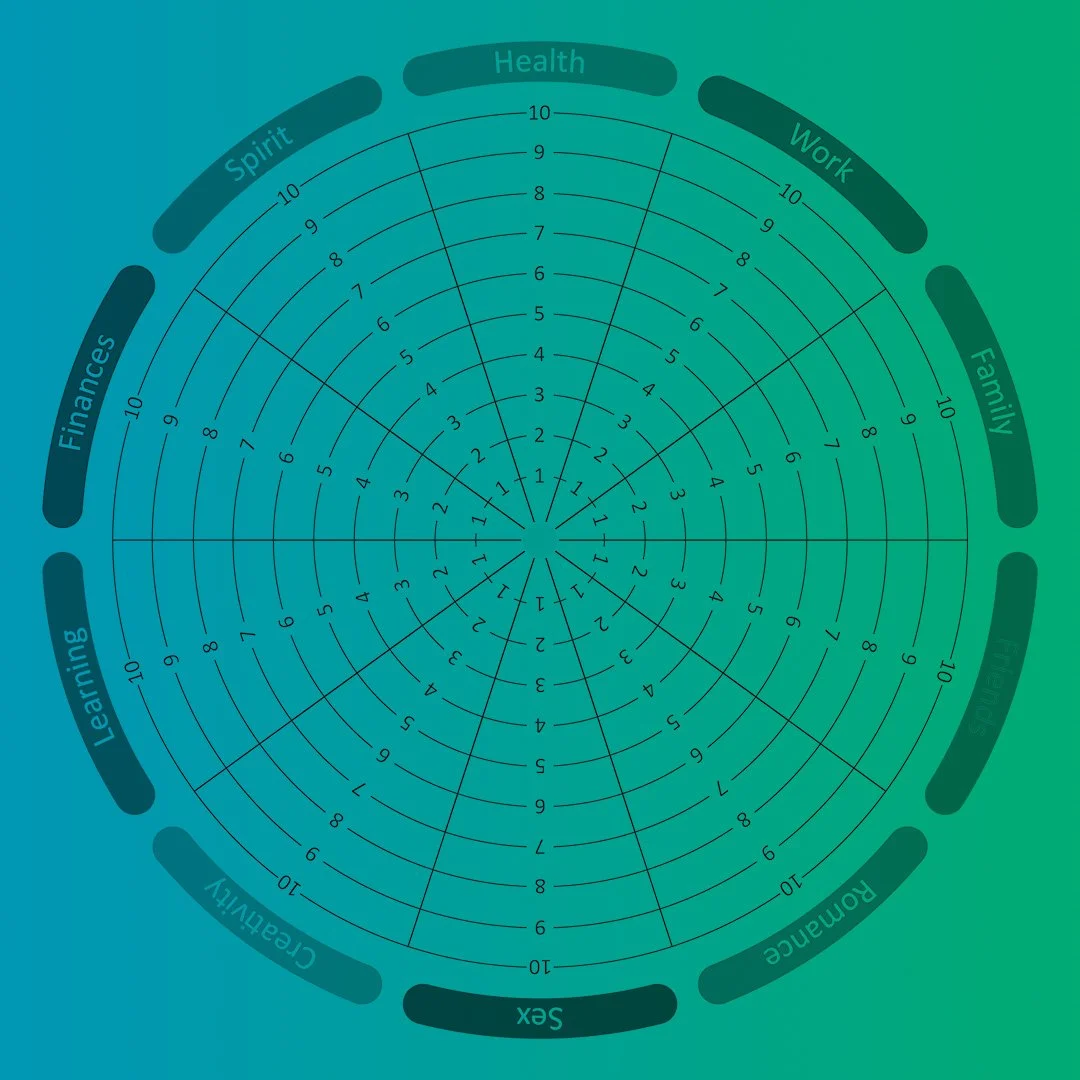
If you aren’t familiar with the Wheel of Life, here is a quick overview.
The Wheel of Life is a self-reflection tool developed by personal development pioneer Paul J. Meyer in the 1960s. It divides your life into eight or more domains - commonly things like Career, Health, Family, Finances, Personal Growth, Fun and Recreation, Relationships, and Physical Environment - and asks you to rate your current level of satisfaction in each area on a scale of 0 to 10. When you plot those scores onto a circular diagram, you get a visual snapshot of how balanced (or unbalanced) your life currently feels.
The exercise works because it turns something vague and overwhelming - "my life feels off" - into something you can genuinely see. A dramatically uneven wheel is not a judgment. It’s information.
If you have never completed one, you can try it for free here: Wheel of Life Assessment - Noomii (At the end, you can click anywhere behind the form when it comes up and you will bypass the form and have access to your wheel.)
If your first instinct after completing the exercise was to feel overwhelmed, you’re not doing it wrong. That feeling is genuinely important information. It means the exercise worked. It showed you something true. The question is what to do with that truth - and the honest answer is that the Wheel of Life was never designed to tell you. It was designed to create awareness. Awareness is the beginning, not the plan.
Here is where most approaches go sideways: they treat the wheel like a to-do list. Every low score becomes a project. You need better boundaries. More exercise. More family time. A hobby, somehow. Sleep. That list becomes another version of the pressure you were already under, just repackaged as self-improvement.
What helps is a different question entirely. Not "what areas need work?" but "where is the biggest gap between how I am living and what matters most to me?"
That is an alignment question, not a balance question. And it leads somewhere much more specific than a self-care checklist.
The Problem Is Not Balance
There is a reason "work-life balance" has become one of the most talked-about concepts in veterinary medicine and one of the least acted upon. The phrase itself may be part of the problem.
Balance implies equilibrium - a more or less equal distribution of energy and time across the domains of your life. For anyone in veterinary medicine, that image does not match reality and probably never will. Some seasons demand everything from you clinically. A difficult case, a staffing shortage, a practice in crisis. Some seasons pull you toward family. Some require recovery. Insisting on equal weight at all times is not just unrealistic; in actuality, it can make people feel like they are failing at wellness on top of everything else they are managing.
The Merck Animal Health Veterinary Wellbeing Study, one of the largest ongoing surveys of veterinary professionals, has consistently found that work-life balance is the single strongest predictor of high wellbeing, low burnout, and good mental health in this profession (Volk et al., 2024). But balance, in that context, does not mean equal hours. It means something closer to what psychologists would call alignment: living in a way that is consistent with what you authentically value.
This differentiation matters. Research on veterinary teams has found that the intrinsic meaningfulness of the work is a key source of wellbeing and job satisfaction, even when the workload is heavy (Cake et al., 2022). In other words, it is not necessarily the number of hours that predicts how people are doing. It is whether those hours feel connected to something that matters to them.
That is an alignment question.
What Values Actually Do

In Acceptance and Commitment Therapy, or ACT, values are not aspirational statements you write on a vision board. Within ACT, values are understood as guiding principles that are ongoing reflections of what an individual finds meaningful. Unlike goals, which can be completed and achieved, values are dynamic and continuous (Lavelock et al., 2018). You never finish living your values. You simply keep moving toward or away from them, choice by choice, day by day.
This framing is particularly useful for veterinary professionals because the profession is already full of people who are deeply values-driven. Most people who go into this work do so because they care - about animals, about science, about the human-animal bond, about their communities. The values are rarely the problem. The gap between those values and how the days realistically unfold is where the difficulty lives.
ACT's central concept of psychological flexibility refers to an individual's ability to remain open to their experiences, stay present, and engage in actions aligned with personal values, even when faced with emotional or cognitive discomfort (Twohig & Levin, 2017). That last part is worth sitting with. The goal is not to wait until conditions are perfect before living in alignment with your values. The goal is to keep moving toward them, especially when conditions are hard.
A few questions that can help you identify where you stand:
What matters most to me right now - not in the abstract, but in this season of my life?
If someone who knew me well described me at my best, what would they say?
Where is the biggest gap between what I say I value and how I am genuinely spending my time and energy?
That last question is the most important one. It moves you from awareness directly into action.
The Alignment Check

Consider a few examples that might feel familiar.
A veterinarian who values family leaves late most evenings - not because she doen’t care, but because the work always has one more thing waiting. She hasn’t chosen work over family. She has simply not made a visible, concrete choice in the other direction.
A technician who values his health eats lunch standing over the treatment table, if he eats at all. Not because health does not matter to him, but because the moment never seems right to step away.
A practice manager who values learning has not read anything for herself in months. The continuing education gets done; the personal growth does not.
In each case, the issue is not character. It is not laziness or lack of commitment. Research on veterinary burnout has identified deeply embedded cultural constructs - presenteeism, the equation of long hours with professional dedication, the ideal of the persevering clinician - as forces that quietly shape behavior in ways individuals rarely consciously choose (Batchelor et al., 2023). The culture pulls in a direction, and people follow without quite noticing.
The alignment check is simply the act of noticing. Where is the biggest gap between what I value and what I am doing in practice? You don’t have to fix everything. You just have to see it clearly.
One Small Shift
Here is where most wellness advice goes wrong again. Having identified the gap, people are told to make a plan. Set goals. Create systems. Build new routines. All of that can be useful, eventually. But for someone who is already running on empty, a five-step self-improvement program is not an invitation. It is another task.
What truly works is smaller than that.
Research on behavior change has consistently shown that small, incremental changes compound into transformative results over time (Clear, 2018). The goal is not a dramatic overhaul. It is a direction. As James Clear puts it, you do not rise to the level of your goals - you fall to the level of your systems, and those systems are built one small, repeatable choice at a time.
Self-Determination Theory, developed by Deci and Ryan, adds another layer to this. It identifies autonomy as one of three core psychological needs essential to wellbeing: the ability to regulate one's actions in a self-directed way, rather than under external pressure or obligation (Deci & Ryan, 2000). When people choose a small action that is genuinely theirs - one that reflects something they genuinely value rather than something they feel they should want - they are more likely to follow through. And following through, even once, starts to shift something.
So instead of a plan, try a single question: what is the smallest change that would bring my life into better alignment with what matters most to me right now?
Not the most impressive change. Not the one that would fix everything. Just the smallest one that is genuinely mine and genuinely meaningful.
Some examples from veterinary professionals who have done this work:
Eating lunch away from the treatment area twice a week, because connection to the rest of the world matters to me.
Leaving on time one evening, because my family is on my list of values even when the work is not done.
Calling a friend during the drive home, because I have let that relationship go quiet for too long.
Spending ten minutes reading something that has nothing to do with medicine, because I used to love learning for its own sake and I miss it.
None of these will transform a life in a week. But each one is a vote for the kind of person you are trying to become. Empirical evidence supports values-consistent living as a meaningful target for sustainable wellbeing, and the research suggests that the mechanism is not complexity or effort - it is simply doing what you said you valued, in a way small enough to truly be possible (Lundgren et al., 2012).
Awareness Is the Beginning

The Wheel of Life is not designed to show you everything that is wrong. It is designed to help you see clearly. That clarity is genuinely valuable, but clarity alone doesn’t create change.
Values give you direction. They tell you which way to face when you are deciding what to do with the awareness the wheel just handed you. Research on wellbeing in veterinary settings consistently shows that negative experiences exist despite this work being worthwhile and highly valued by those who do it (Scotney et al., 2015). That is not a contradiction. It is a description of a profession that carries a great deal, and that deserves better tools than vague advice about self-care.
Sustainable wellbeing is rarely built through dramatic change. More often, it is built through small decisions repeated over time, made by people who have taken the time to know what they are moving toward.
Awareness creates choice. Values provide direction. Action - even the smallest action - creates change.
————
Further Reading
The ideas in this article are drawn on research from several areas. If you want to go deeper, these are good places to start.
Acceptance and Commitment Therapy (ACT)
Lavelock, C. R., et al. (2018). A systematic review of values measures in acceptance and commitment therapy research. Journal of Contextual Behavioral Science, 10, 33–43. https://doi.org/10.1016/j.jcbs.2018.10.003
Lundgren, T., Luoma, J. B., Dahl, J., Strosahl, K., & Melin, L. (2012). The Bull's-Eye Values Survey: A psychometric evaluation. Cognitive and Behavioral Practice, 19(4), 518–526. https://doi.org/10.1016/j.cbpra.2012.01.004
Twohig, M. P., & Levin, M. E. (2017). Acceptance and commitment therapy as a treatment for anxiety and depression. Psychiatric Clinics of North America, 40(4), 751–770.
Veterinary Wellbeing and Burnout
Cake, M. A., et al. (2022). A mixed methods investigation of stress and wellbeing factors contributing to burnout and job satisfaction in a specialist small animal hospital. Frontiers in Veterinary Science, 9, 942778. https://doi.org/10.3389/fvets.2022.942778
Batchelor, C., et al. (2023). A narrative review of the physiology and health effects of burnout associated with veterinarian-pertinent occupational stressors. Frontiers in Veterinary Science, 10, 1184525. https://doi.org/10.3389/fvets.2023.1184525
Volk, J. O., et al. (2024). Work-life balance is essential to reducing burnout, improving well-being. Journal of the American Veterinary Medical Association, 262(7). https://doi.org/10.2460/javma.24.02.0135
Behavior Change and Habit Formation
Clear, J. (2018). Atomic Habits: An Easy and Proven Way to Build Good Habits and Break Bad Ones. Avery.
Self-Determination Theory
Deci, E. L., & Ryan, R. M. (2000). The "what" and "why" of goal pursuits: Human needs and the self-determination of behavior. Psychological Inquiry, 11(4), 227–268.
Ryan, R. M., & Deci, E. L. (2017). Self-Determination Theory: Basic Psychological Needs in Motivation, Development, and Wellness. Guilford Press.
The Wheel of Life
Meyer, P. J. (1960s). Original Wheel of Life framework. Paul J. Meyer Institute. For a free online version, visit: https://wheeloflife.noomii.com/